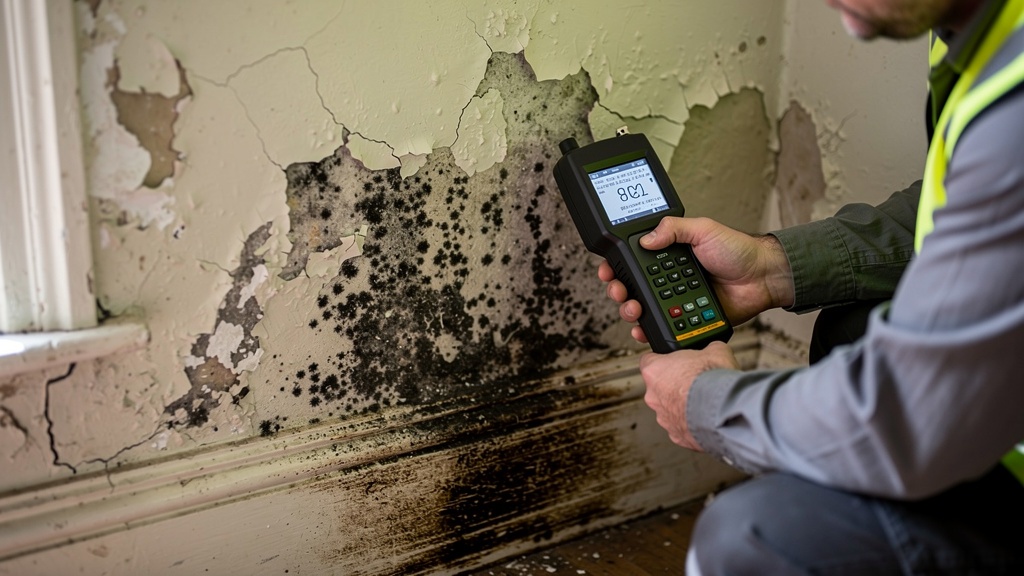
Damp is one of the most misunderstood problems in UK property. It is also one of the most frequently misdiagnosed — and, as a result, one of the most over-treated. At Battersea Surveyors, damp is something we investigate every single week. In our Victorian terrace-heavy patch of South West London, it is arguably the single most common defect we encounter. This guide sets out exactly what damp is, how to tell the different types apart, and what you should actually do about it.
The Three Types of Damp: Understanding the Basics
There is no single thing called "damp". In building surveying, we distinguish between three very different phenomena:
1. Condensation
Condensation is by far the most common form of dampness in UK homes — accounting for well over 70% of all damp problems we investigate. It occurs when warm, moisture-laden air meets a cold surface and the water vapour condenses into liquid water. You see this every time you have a cold shower and the mirror steams up, or when your windows run with water on a cold morning.
In homes, condensation typically appears on cold external walls (especially in corners, behind furniture and around window frames), on north-facing walls that receive little solar heat, and in poorly ventilated spaces such as bathrooms and kitchens. The result is surface mould — the familiar black spotting that looks alarming but is often, in structural terms, the least serious form of damp.
Condensation is caused primarily by lifestyle and ventilation. Cooking, showering, drying clothes indoors, even breathing — all release significant moisture into the air. A family of four can produce up to 10 litres of water vapour per day just through normal daily activities. Without adequate ventilation and heating, that moisture has nowhere to go but onto your walls.
2. Rising Damp
Rising damp is the one everyone has heard of — and the one the damp-proofing industry most loves to diagnose. True rising damp occurs when moisture from the ground travels upward through the masonry of a wall via capillary action: the same process that draws water up a thin glass tube when you dip it in a liquid.
The tell-tale signs of genuine rising damp include:
- A damp "tide mark" or horizontal staining on the wall, typically up to about 1 metre from the floor level
- Salt crystallisation (efflorescence) — white powdery deposits left behind as moisture evaporates
- Damaged plaster, particularly a crumbling, powdery texture
- Damage concentrated in the lower section of the wall, not the upper
- Problems worsening in winter and improving in summer
Here's the important caveat: genuine rising damp is rarer than the damp-proofing industry would have you believe. A 2011 study by the BRE (Building Research Establishment) concluded that many properties diagnosed with rising damp actually had condensation, bridged damp-proof courses, or penetrating damp. Always get an independent opinion from an RICS surveyor before commissioning expensive damp-proofing works.
3. Penetrating Damp
Penetrating damp — also called lateral damp — occurs when moisture enters the building fabric through defects in the external envelope: leaking roofs, blocked or damaged gutters, cracked render, failed window seals, defective flashings, or missing pointing in brickwork. Unlike rising damp, penetrating damp is not limited to the lower parts of a wall. It can appear anywhere in the building where there is a breach in the waterproof envelope.
Penetrating damp is often the easiest to fix: identify the source of the water ingress, repair it, and allow the building to dry out. The repair might be as simple as repointing a chimney stack or replacing a gutter bracket. But left untreated, it can lead to serious structural problems, timber rot and extensive internal damage.
Why Victorian Properties in Battersea Are Particularly Susceptible
If you live in one of Battersea's characteristic Victorian terraces — and most people in the area do — you need to understand how your house was built to understand why damp behaves the way it does in it.
Victorian houses were designed to breathe. The walls were built in lime mortar, which is softer and more permeable than modern cement. The plaster was lime-based. The paint was oil-based or distemper. The entire system was designed to absorb a little moisture and release it again — a slow, gentle process that kept walls in equilibrium without causing damage.
Problems arise — and they arise very commonly in Battersea's Victorian housing stock — when subsequent owners have intervened with modern materials that break this system:
- Cement repointing — harder and less permeable than the original lime mortar, cement pointing traps moisture inside the wall rather than allowing it to evaporate from the joints.
- Gypsum plaster over old lime — gypsum plaster is not designed for walls that carry moisture. It bubbles, cracks and falls away, creating the very appearance of a damp problem while actually being the consequence of a previous "improvement".
- External masonry paints — some masonry paints are not vapour-permeable. Applied to a Victorian wall, they can trap moisture inside the wall, accelerating decay and creating internal damp patches.
- Solid concrete floors — Victorian properties often had permeable solid ground floors (usually flagstones on sand). These were replaced in many cases with solid concrete, which can bridge the damp-proof course and allow moisture to travel up adjacent walls.
I remember surveying a beautiful Victorian terrace on Battersea's Comyn Road a couple of years ago. The owners were convinced they had severe rising damp — the damp-proofing company they'd called in had quoted them £8,000 for a chemical injection DPC and re-plaster. When I investigated, the real cause was a combination of poor ventilation in the ground-floor rear room and cement repointing on the rear elevation that was trapping moisture. The fix involved improved trickle ventilators in the windows, removing the cement pointing and replacing it with lime, and allowing the wall to dry out naturally. Total cost: under £1,500. And no chemical injection required.
How a Chartered Surveyor Diagnoses Damp
When we investigate damp at Battersea Surveyors, we use a combination of visual inspection and specialist equipment. Here's our process:
Moisture Meter Readings
A moisture meter gives us a relative reading of moisture content in a wall or floor. We probe multiple points at different heights and locations to build a picture of where moisture is concentrated. High readings at low level that decrease as you go higher suggest rising damp. High readings concentrated around windows or below a parapet suggest penetrating damp. High readings on cold external walls in north-facing rooms, combined with surface mould but no structural damage, point to condensation.
Importantly, a moisture meter reading alone does not diagnose the type of damp. The meter reads moisture — it cannot tell you why it's there. Context is everything.
Boroscope Investigation
For intrusive investigations, we use a boroscope — a flexible camera probe — to look inside wall cavities and floor voids. This is particularly useful when we need to check the condition of a damp-proof course, look for signs of cavity bridging, or investigate the space beneath a suspended timber floor for damp or rot.
Thermal Imaging
Thermal imaging cameras detect temperature differences on wall surfaces. Damp areas conduct heat differently from dry areas, so cold spots on a thermal image can indicate areas of moisture concentration. We increasingly use thermal imaging as a non-invasive way to screen large wall areas quickly.
Reviewing the Building's History
We always ask owners about previous works, when the problem started, and whether it's seasonal. A damp patch that appears only after heavy rain and is located below a flat roof tells a very different story to one that has been present year-round for decades. Context is as important as any reading from a meter.
Damp Treatment: What Works and What Doesn't
The UK has a sizeable industry devoted to damp-proofing — and not all of it offers good value. Here's an honest assessment of the main treatment options:
For Condensation
The most effective treatments for condensation are behavioural and mechanical — not chemical. They include:
- Installing extract fans in kitchens and bathrooms (with humidistat controls for automatic operation)
- Fitting trickle ventilators in window frames
- Improving whole-house ventilation with a Mechanical Ventilation and Heat Recovery (MVHR) system in extreme cases
- Ensuring adequate background heating — a cold house is far more susceptible to condensation than a well-heated one
- Drying clothes outside or using a tumble dryer vented to the outside
- Keeping furniture away from external walls to allow air circulation
Mould growth should be treated with a fungicidal wash before redecorating. Simply painting over mould will not solve the problem — the mould will return unless the underlying condensation issue is addressed.
For Rising Damp
If genuine rising damp is confirmed, treatment options include:
- Chemical injection DPC — a silicone-based liquid is injected into the wall at low level, creating a water-repellent zone. Effective when used correctly, though it is often over-specified.
- Electro-osmotic DPC — an electrical system that uses the principle of electro-osmosis to drive moisture back down. Evidence for its effectiveness is mixed.
- Drainage and tanking — for basement or below-ground moisture problems, tanking (waterproof render or membrane systems) is usually the more appropriate solution.
- Improving drainage — sometimes the simplest fix is lowering external ground levels that have been raised above the damp-proof course, or improving surface water drainage away from the building.
For Penetrating Damp
The treatment is always to find and fix the source of water ingress first. Common repairs include:
- Replacing cracked or missing roof tiles
- Clearing blocked gutters and downpipes
- Repointing brickwork (in lime mortar, not cement, on Victorian properties)
- Replacing failed window and door seals and flashings
- Applying breathable waterproof treatment to external render or stonework
Once the source is repaired, the building should be allowed to dry naturally before internal redecoration — which can take months in the case of thick solid walls.
Damp and Your Property Survey
All of our Level 2 HomeBuyer Reports and Level 3 Building Surveys include a thorough investigation of damp and moisture issues. We use moisture meters on every surveyed property and specifically examine the areas most prone to problems: ground floor rooms, bathrooms, kitchens, rooms with north-facing external walls, and any room with a chimney breast or recently replastered wall.
If we find elevated moisture readings or visible mould and damp staining, we explain what we found, what we think is causing it, and what you should do about it. We do not simply flag "damp present" without context. Context — cause, severity, likely remedy, likely cost — is what helps you make an informed decision about buying (or not buying) a property.
"The biggest mistake buyers make is asking the seller to commission damp-proofing works before exchange. If the diagnosis is wrong — and it often is — the wrong treatment can make matters worse. Much better to get an independent damp investigation first, understand the cause, and negotiate accordingly."— Sarah Mitchell, MRICS, Battersea Surveyors
Damp in Rented Properties: Tenant Rights
If you are a tenant experiencing damp or mould in a rented property, it is important to know your rights. Since the Homes (Fitness for Human Habitation) Act 2018, landlords are legally required to ensure their properties are free from hazards that make them unfit for habitation — and persistent mould and damp is classified as such a hazard.
Furthermore, following the tragic death of two-year-old Awaab Ishak in Rochdale in 2020 — where mould was found to have contributed to his death — the Government introduced Awaab's Law (now incorporated into the Renters (Reform) Act 2024). This law requires social landlords to investigate and repair damp and mould hazards within strict timeframes. While the law initially applies to social housing, further reforms are expected to extend similar obligations to private landlords.
If your landlord refuses to investigate or repair damp and mould:
- Report the problem in writing (email or letter, dated)
- Contact your local council's environmental health team
- In England, apply to the First-tier Property Tribunal for a Rent Repayment Order
- Seek free advice from Citizens Advice or Shelter
How Much Does Damp Treatment Cost?
Costs vary enormously depending on the type, cause and extent of damp. Here's a rough guide based on our experience of the London market:
| Damp Type / Treatment | Typical Cost Range (London) |
|---|---|
| Extractor fan installation (kitchen or bathroom) | £150 – £400 per fan |
| Trickle ventilator installation | £50 – £150 per window |
| Gutter repair / replacement | £200 – £1,500 |
| Repointing (per metre run) | £25 – £60 per m² |
| Chemical DPC injection (per metre run) | £70 – £120 per metre |
| Re-plastering (rising damp zone) | £800 – £3,000 per room |
| Basement tanking (full system) | £5,000 – £30,000+ |
| Independent damp investigation (RICS surveyor) | £300 – £600 |
Always get at least three quotes for remediation work. And — especially for rising damp — always get an independent surveyor's opinion before commissioning any treatment. The cost of an independent survey is usually a fraction of what you'll save by avoiding unnecessary remediation works.
Frequently Asked Questions
What is the difference between rising damp and condensation?
Rising damp is moisture from the ground travelling upward through masonry, leaving a characteristic tide mark up to about 1 metre high. Condensation is moisture from the air settling on cold surfaces — far more common and usually caused by inadequate ventilation and heating rather than a structural defect.
Is rising damp common in Victorian properties?
True rising damp in Victorian properties is less common than many damp-proofing companies suggest. Problems often arise when breathable lime materials are replaced with impermeable cement renders and modern plasters, trapping moisture inside the wall rather than allowing it to evaporate naturally.
How much does damp treatment cost?
Condensation treatment can cost very little — sometimes just changes to ventilation habits. Chemical DPC injection costs typically £500–£3,000. Structural waterproofing for basements can range from £5,000 to £30,000 or more depending on size and complexity.
Do surveyors check for damp?
Yes. All RICS building surveys (Level 2 and Level 3) include damp checks using a moisture meter. Surveyors probe walls, floors and ceilings for elevated moisture readings and visually inspect for damp staining, mould growth, damaged plaster and other signs of moisture ingress.
Should I be worried if a survey flags damp?
It depends on the type and cause. Condensation is very common and usually straightforward to address. Rising damp is rarer but may require remedial work. Penetrating damp often simply needs a repair to a roof, gutter or window seal. Context is everything — your surveyor's report should explain the likely cause and the recommended remedy.
Can damp affect the value of a property?
Yes. Evidence of untreated damp — particularly mould and damaged plaster — can reduce a buyer's offer significantly. However, most damp problems are treatable. Having a professional report that clearly identifies the cause and remedy can actually help a sale rather than hinder it.
What is a damp proof course (DPC)?
A damp proof course (DPC) is a horizontal barrier built into masonry walls at low level to prevent moisture rising from the ground. Modern properties have a physical DPC of impermeable material. Older Victorian properties may have a slate DPC that has degraded or been bridged by raised ground levels or internal floors.
Worried About Damp? Talk to Battersea Surveyors
Damp problems don't always need expensive treatment — but they do need accurate diagnosis. At Battersea Surveyors, we've helped hundreds of property owners, buyers and landlords in Battersea and across South West London understand exactly what's happening with their property — and what to do about it.
If you're buying a property and want a thorough damp investigation included in your survey, or if you're a homeowner or landlord seeking an independent report on a specific damp problem, get in touch today. We cover the whole of Battersea, Wandsworth, Clapham, Chelsea, Fulham and surrounding areas.