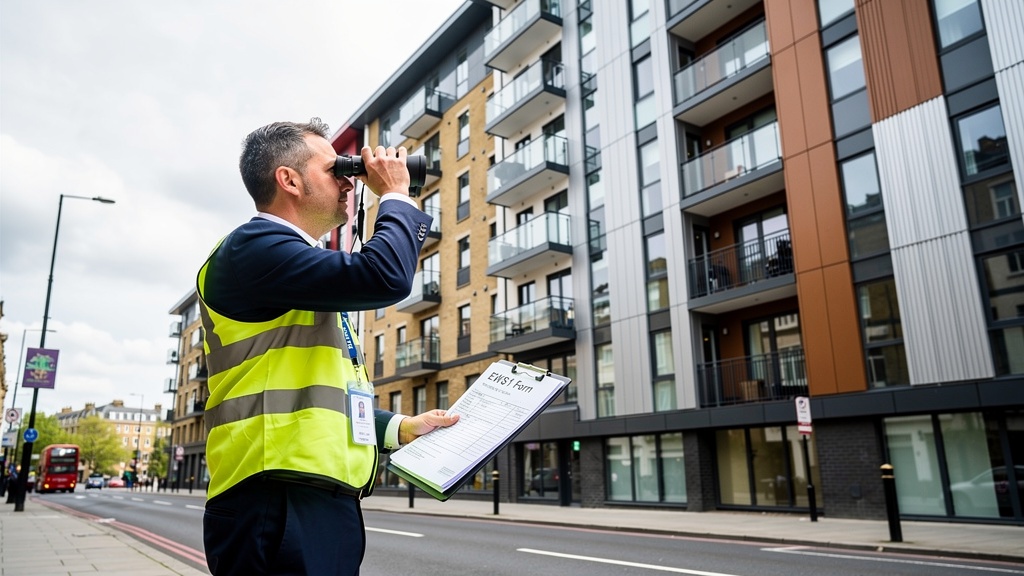
If you own a leasehold flat in London — particularly in a modern apartment block — the words cladding survey and EWS1 form have probably kept you up at night. Since the Grenfell Tower tragedy in June 2017, the building safety landscape in the UK has changed beyond recognition. As Battersea Surveyors, we've guided dozens of flat owners through this complex and often frightening process. This guide cuts through the confusion and gives you the facts you need.
What Changed After Grenfell?
The Grenfell Tower fire — which claimed 72 lives — exposed serious failings in the way high-rise residential buildings were constructed, maintained and regulated. The investigation that followed revealed that ACM (Aluminium Composite Material) cladding with a polyethylene core had been used on thousands of buildings across the country. This type of cladding is now classified as highly flammable and unsafe.
But Grenfell wasn't just about one type of cladding. Subsequent investigations found a wide range of combustible materials used in external wall systems on buildings of all heights: HPL (high-pressure laminate) panels, insulation products such as PIR and EPS foam, and timber-framed balconies all came under scrutiny.
The result was a mortgage market crisis. Lenders — suddenly aware of the fire safety risks — stopped lending on thousands of flats. Buyers couldn't get mortgages. Sellers couldn't sell. People were trapped in flats they couldn't afford and couldn't leave. It was — and in some cases still is — devastating.
What is the EWS1 Form?
The EWS1 (External Wall Survey) form was introduced in December 2019 by UK Finance, the Building Societies Association and RICS as a standardised way for building owners to demonstrate the fire safety of their external wall system to mortgage lenders.
An EWS1 form is completed by a qualified fire safety professional — such as a chartered fire engineer, a RICS-registered building surveyor with the relevant competencies, or a chartered structural engineer. It is not something a general building inspector can do. The form records:
- Whether the external wall contains combustible materials
- The risk level (A1, A2, B1 or B2)
- What remediation, if any, is required before the building is considered safe
An A1 or A2 rating means no combustible materials were found and the building can be mortgaged normally. A B1 rating means combustible materials were found but fire risk is sufficiently low that no remediation is needed — most lenders will accept B1. A B2 rating is the most serious: combustible materials are present and remediation is required before lenders will proceed.
I remember one client — let's call her Priya — who came to us in 2022 in tears. She'd accepted an offer on her one-bedroom flat in Battersea and everything had been going smoothly until her buyer's lender demanded an EWS1 form. The managing agent of her building had no idea what it was. Four months of delays followed, and the sale eventually fell through. Stories like Priya's were heartbreakingly common.
Does Your Building Need an EWS1 Form?
The original RICS guidance suggested that EWS1 forms were required for all buildings over 18 metres. However, revised guidance issued in 2021 — reflecting pressure from the government and housing market — changed the position significantly. The current position is broadly as follows:
- Buildings over 18m (roughly six storeys): An EWS1 will almost always be required if the building has any cladding or specific external wall features.
- Buildings between 11m and 18m: An EWS1 may be required depending on the external wall system and the lender's individual requirements.
- Buildings under 11m: An EWS1 is generally not required, though some lenders and managing agents may still ask for one if they have concerns.
The key variable is always the lender. Different lenders have different policies, and those policies change. If you're buying, selling or remortgaging a flat, your solicitor and mortgage broker need to be aware of your building's situation from day one.
The Building Safety Act 2022: A Game Changer
In April 2022, the Building Safety Act received Royal Assent. For leaseholders trapped by cladding costs, it was — eventually — good news. The Act introduced several critical protections:
Leaseholder Protections
Qualifying leaseholders — those who own a leasehold flat in their only or main home, or who owned it as a non-resident leaseholder at 14 February 2022 — are legally protected from paying for cladding remediation costs. The building must be over 11 metres tall or have more than five storeys. The cost of removing and replacing unsafe cladding must fall on the developer, the landlord or the building owner — not the leaseholder.
For non-cladding defects (such as fire doors, balconies and fire-stopping), the Act also caps what leaseholders can be asked to pay — based on a sliding scale related to the value of the flat. Buildings over 11m have strict caps on service charges for remediation works.
The Developer Pledge
By March 2023, 49 major housebuilders had signed a Government developer pledge, committing to fund remediation on buildings they built or developed in the 30 years before the Act. If your building was built by one of these developers, there is a specific remediation pathway you may be able to access.
The Building Safety Fund
The Government's Building Safety Fund (originally launched in 2020 and expanded several times since) provides grant funding for remediation works where no developer can be identified or held responsible. If your building is eligible, remediation costs should not fall on leaseholders at all.
What Does a Cladding or Building Safety Survey Involve?
A full building safety assessment is a significant undertaking. Here's what typically happens:
Step 1: Desktop Review
The qualified professional starts by reviewing planning documents, architectural drawings, building control certificates and any existing fire risk assessments. This helps establish what materials were specified and approved — though what was actually built isn't always what was designed.
Step 2: Visual Inspection
The inspector carries out a visual inspection of the external wall system from ground level and, where accessible, from balconies and common areas. Binoculars, drones and remote cameras are often used.
Step 3: Intrusive Investigation
Where doubt exists about what lies beneath the cladding, an intrusive investigation is required. Small sections of the external wall are opened up — usually from inside the building or from scaffolding — to reveal the wall build-up and identify materials. Samples may be taken for laboratory analysis.
Step 4: Report and EWS1 Completion
The qualified professional produces a report setting out their findings, risk assessment and recommendations. If appropriate, they complete the EWS1 form. The form is then shared with managing agents, freeholders, mortgage lenders and, ultimately, buyers and sellers.
Cladding Issues in Battersea and the Nine Elms Area
Battersea has seen extraordinary levels of new residential development in the past decade, particularly in the Nine Elms and Battersea Power Station regeneration zone. Many of these buildings — constructed between 2010 and 2022 — are within scope for building safety assessments.
We've been involved in a number of building safety matters in the SW8 and SW11 postcode areas, acting for both individual leaseholders seeking advice and for residents' management companies commissioning formal assessments. The experience has been educational, to say the least.
One thing that surprises many of our clients is that Battersea's famous Victorian terraces — the red-brick houses that characterise so much of the area — are generally unaffected by the cladding crisis. The issue relates specifically to buildings with external wall systems that include non-masonry cladding panels and insulation boards. Traditional brick-built properties don't have these problems.
Selling or Buying a Flat With Cladding Issues
If you're trying to sell a flat in a building with unresolved cladding issues, here's what we'd advise:
- Get a copy of any existing EWS1 form from your managing agent or freeholder. If one exists and shows a B2 rating, be aware that most lenders will not lend until remediation is complete.
- Find out what remediation stage the building is at. Has a remediation plan been agreed? Is the building in the Building Safety Fund? Has a developer pledged to fund the works? The clearer the pathway to resolution, the easier a sale will be.
- Be transparent with buyers. You are legally obliged to disclose known building safety issues as part of the conveyancing process. Trying to hide problems creates serious legal risk for you.
- Consider cash buyers. Some buyers with cash — not requiring a mortgage — may be willing to proceed with an appropriate reduction in price, particularly if remediation is underway or funded.
- Instruct a RICS surveyor to advise on the impact of cladding issues on your property's value. A formal RICS Red Book valuation can also be useful for negotiating with buyers.
If you're buying a flat in a building with potential cladding issues, we would always recommend a Level 2 HomeBuyer Report at minimum — and ideally a Level 3 Full Building Survey. Your surveyor should specifically comment on the external wall system and any known or suspected building safety issues.
"We always include a specific section on building safety in our survey reports for flats built after 2000. If there are any indicators of external cladding or concerns about external wall materials, we flag them clearly and recommend further specialist investigation. It's one of the most important things we can do for our clients right now."— James Hartley, MRICS, Battersea Surveyors
Your Rights as a Leaseholder: The Key Points
The landscape of leaseholder rights in relation to building safety has improved enormously since 2017. Here are the key points to understand:
- You cannot be made to pay for cladding remediation if you are a qualifying leaseholder under the Building Safety Act 2022 and your building is over 11m.
- You have the right to information about your building's safety status. Freeholders and managing agents must respond to requests for building safety information.
- You can challenge service charges at the First-tier Tribunal if you believe building safety remediation costs are being passed to you unlawfully.
- The Building Safety Regulator (part of the Health and Safety Executive) oversees high-rise residential buildings and provides a route for escalating concerns.
- Free legal advice is available from the Leasehold Advisory Service (LEASE) and from some solicitors' firms that specialise in building safety matters.
What Happens Next? The Future of Building Safety
The remediation crisis is far from over. As of early 2025, thousands of buildings across England are still in the process of investigation or remediation. The Government's targets for completing cladding remediation have repeatedly slipped. For many leaseholders, the nightmare continues.
However, the legal and regulatory framework is now significantly stronger than it was in 2017. Developers are under greater pressure to act. The Building Safety Regulator is operational. And the courts have provided important judgments clarifying leaseholder rights.
From a surveying perspective, we expect building safety to remain a core part of our work for the next decade. We're committed to staying at the forefront of the guidance, attending CPD events run by RICS and the Building Safety Alliance, and ensuring our clients get the most up-to-date advice possible.
Frequently Asked Questions
What is an EWS1 form?
An EWS1 (External Wall Survey) form is a standardised document completed by a qualified professional confirming whether the external wall system of a residential building is safe. It was introduced after the Grenfell Tower fire to help lenders and buyers assess fire safety risks on buildings with combustible cladding.
Do I need an EWS1 form to sell my flat?
Not always. EWS1 forms are generally required for buildings with cladding systems where a mortgage lender deems a fire safety assessment necessary. Your solicitor and lender will advise whether one is needed in your specific case.
Who pays for cladding remediation on a leasehold flat?
Under the Building Safety Act 2022, qualifying leaseholders are legally protected from paying for cladding remediation costs on buildings over 11 metres. Developers and building owners are expected to fund these works. However, the rules are complex and it is vital to take specialist legal and surveying advice.
How long does a building safety assessment take?
A desktop review can take a few days. A full intrusive survey can take anywhere from one day to several weeks depending on building size, access arrangements and the complexity of the external wall system.
Can I get a mortgage on a flat with cladding issues?
It depends. Some lenders will lend on flats with an EWS1 rating of B1 or A1/A2. Others will not lend until remediation works are complete. Always instruct a solicitor and surveyor who are familiar with current lender requirements.
Talk to Battersea Surveyors
Navigating the building safety landscape is genuinely complex — but you don't have to do it alone. Whether you're trying to understand your EWS1 rating, need a survey report that addresses building safety, or simply want an expert opinion on a flat you're considering buying, the team at Battersea Surveyors is here to help.
We cover Battersea, Wandsworth, Nine Elms, Chelsea, Clapham, Lambeth and all of Central and South West London. Get in touch today for a no-obligation conversation.